
Prevention of harassment
Harassment is ...
Harassment is behavior that not only violates people’s human dignity and personal rights, but also infringes on their rights to enjoy a good environment in which to learn, teach, do research, and work.
Harassment occurs in many forms, including sexual, academic, power, and alcohol harassment. Some cases involve several different types of harassment.
Prevention of harassment
Hitotsubashi University has the duty and responsibility to protect the above rights.
To fulfill this duty and responsibility, and to help ensure that everyone in the University community can fully exercise their abilities, the University has formulated guidelines that include measures to prevent and eliminate harassment.
The University has also established a Harassment Consultation Office.
There are many types of harassment
1. Sexual harassment
- Making remarks such as “Because you are a man” or “Being a woman, you are in no position to…” in class or the workplace.
- Putting pressure on someone to give up either marriage and child-bearing or their job, citing a negative influence on research and performance.
2. Academic harassment
- Without due reason, setting limits on research or giving unfair assessment of a student’s performance.
- Without due reason, refusing to allow a student to change their principal supervisor.
3. Power harassment
- Making inappropriate remarks regarding ability and personality.
- Deliberately withholding essential information about work.
4. Harassment related to pregnancy, childbirth, and childcare leave
- Persistently ask questions such as when to give birth.
- Saying heartless words about pregnancy and childbirth that forcing to retire because of pregnancy.
5. Alcohol harassment
- Coercing someone into drinking.
6. Violation of moral rights and privacy rights
- Posting contents that degrades the social reputation of others on social media (such as Twitter or Facebook)
- Telling a friend or colleague about facts in one’s personal life that may be perceived as facts.
Harassment Consultation Office
The Harassment Consultation Office at Hitotsubashi University (Kunitachi Campus: LS/CGEE Building, East Campus) has professional advisors ready to provide consultation to students, graduate students, faculty and staff about any form of harassment. If you feel that you have been harassed, or are worried that you might have harassed someone, please feel free to contact us.

Harassment Consultation Office
| TEL | |
|---|---|
| harassment@ad.hit-u.ac.jp | 042-580-8148 |
To make an appointment
Please contact us by e-mail or telephone to make an appointment. The office is open on Tuesday, Wednesday, and Friday 10:00–12:00 and 13:00–16:00. When making an appointment, please provide the following information: your name, your department or program, and the date and time you would like to meet us. Your privacy and personal information will be strictly protected.
How we can help you
If you feel/notice any harassment(s) occurs, you are able to talk to the harassment advisor(s) at Harassment Consultation Office. You are able to email (harassment@ad.hit-u.ac.jp), call (042-580-8148), and/or visit us for an appointment. You may also visit us anytime without an appointment. Our office hour is Tuesday, Wednesday, and Friday 10:00–12:00 and 13:00–16:00.
Even though you are not sure if your situation is defined as “harassment,” you are more than welcome to visit us anytime. In your consultation, your advisor(s) will help you to organize your situations and feelings, to find some ways you can do, and/or to utilize available resource to solve your situations.
After confirming your consent and request, we can also help you to make adjustments for a betterment of your situations in cooperation with your department.
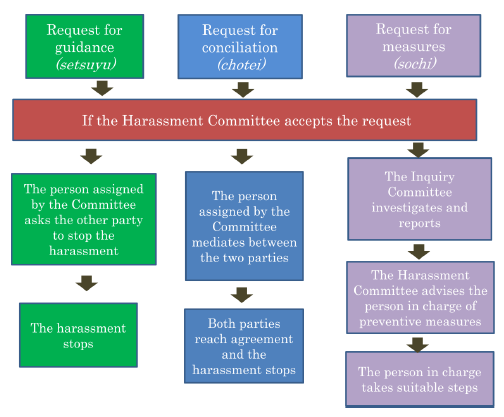
The Grievance System
If it is deemed necessary to make an official request to resolve the issue, one of three procedures: request for guidance, request for conciliation, and request for measures against the opponent(s), will be available. Please ask the advisor at the Harassment Consultation Office about the details and procedure.
Guidelines
External Resources Available
Outside of the university – Public organizations
https://www.hit-u.ac.jp/harassment/gakugai.html
